
In case you expect a tax refund, it’s generally fine. However, even if you decide not to file a return for your departure year, you still should report your date of departure and update your address with the CRA. This is particularly important if you received GST credits or other benefits.
Why am I getting such a small tax refund?
If you’ve worked in Canada as a temporary worker, you might be surprised by how small your tax refund is—or even wonder why you’re owing taxes. The truth is, there’s a logical explanation behind it, and understanding the rule can help you avoid surprises.
First, it helps to look at tax refunds differently. Getting a high tax refund isn’t necessarily a good thing. A high tax refund means the government withheld too much money from your paycheck during the year and is only now returning it to you. In other words, that’s money you could have been using throughout the year for essentials, like food and rent or even for your road trip. Makes sense?
Why your tax refund might be small
Your tax refund as a temporary worker depends primarily on three things:
How much you earned in total
How much tax was already withheld from your paychecks
When you entered or left Canada during the tax year
From over 10 years of experience in the Taxback Service, there’s one typical reason for lower refunds: employers calculate payroll using the full annual tax credits, even if you arrived partway through the year or left before the year ended.
The tax rule in Canada in simple words:
If you entered or left during the tax year, the tax credits can only be claimed for the days you were in Canada.
This rule is actually logical: Why should you receive tax credits for a time when you weren’t living in Canada? The credit is therefore calculated proportionally to the time you were actually in the country.
IEC participants often experience this disappointment with the tax credits proration, especially if they were expecting a high tax refund.
For presentation purposes, here is a very basic example:
Annual Federal Tax Credit for 2025: $16,129
Departure: May 1, 2025
Time in Canada: 120 days
(16,129 ÷ 365) × 120 = $5,301.04
The software will automatically claim $5,301.04 in federal tax credits on your tax return.
Notice the difference compared to the full annual credit of $16,129? The tax credit is adjusted according to the number of days you were in Canada during 2025.
This means that all income above this amount will be taxed at the applicable tax rate, and the taxes already deducted will be applied toward your total tax liability.
Here's a real life typical example with exact dates:
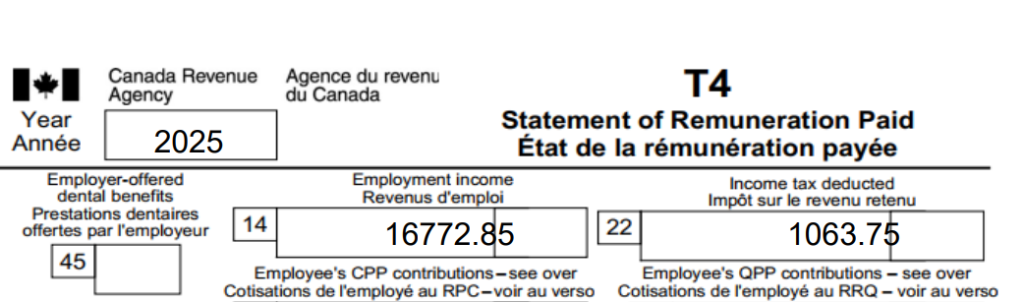
Annual federal tax credit 2025: $16,129
- Income according to T4: $16,772.85
- Taxes withheld according to T4: $1,063.75
At first glance, you might expect a high tax refund of around $1,000, since the income is only slightly above the annual tax credit.
However, the date of your departure from Canada can have a significant impact on the calculation.
Departure: July 15, 2025
Time in Canada: 196 days
As a result, the tax credit is calculated only proportionally and amounts to $8,661.95. It means, all income over this amount must be taxed.
Since the departure occurs mid-year, the tax refund is correspondingly low. In this example, the tax software calculated a refund of only $44.33 (after prorating the provincial tax credits as well).
It’s always hard to break this news to clients, and even harder to explain, but unfortunately, this is how taxes work in Canada.
Answers to many questions from IEC participants
Can I get around this rule?
No. The rule is built into the Canadian tax system and automatically applied by the tax software. Providing false entry or departure dates to “trick” the system can lead to reassessments or penalties.
Is it possible that I might even end up owing taxes?
Yes, it’s possible to owe taxes. This happens if the income tax withheld from your paychecks during the year was less than your actual tax liability.
In such cases, filing a tax return becomes mandatory, because the CRA needs to collect the amount you still owe.
Failing to file when you owe taxes can lead to penalties and interest, so it’s important to submit your return on time.
The tax filing deadline is April 30th.
Do I have to file a tax return?
In Canada, you generally only have to file a tax return if you owe taxes.
However, if you expect a refund, filing a tax return is voluntary — so you can choose not to file.
Depending on the amount of the refund, you should consider whether the effort is worthwhile. You should consider:
- service fees for preparing the tax return
- bank fees for cashing a foreign cheque
- possible exchange rate costs
Will I have problems entering Canada later if I don’t file a tax return?
No. The CRA (Canada Revenue Agency) does not communicate with border or immigration authorities about your taxes. Not filing a return won’t affect your future entry into Canada.
What if I don’t file a tax return?
Why is this important?
Depending on when you left Canada, you may have to repay part or even all of the credits. By reporting your departure and providing the correct address, you ensure that everything is settled correctly and that you don’t run into any problems. >> Here I explain these GST credits <<
Here’s how you can change your address:
- Online: in your CRA account after you have registered.
- By phone
- By mail: Use form RC325 and send it to the address mentioned on the form.
Even if you have already left Canada, you can still reach the Canadian tax authority by phone.
Keep in mind that their lines can be quite busy, so it’s a good idea to call when you have some time to spare.
Phone numbers:
- Inside Canada: 1 (800) 959-8281
- Outside Canada: 001-613-940-8495
Be sure to have a copy of your most recent tax return or Notice of Assessment handy, as the CRA will ask questions based on those documents to verify your identity.
For a more affordable call, you could use a Wi-Fi calling app to reach Canada.
Others reported they were successful with the Fongo World Edition App.
With the app and a one time payment you will get a Canadian number and then you can call the 1800 number for free (I haven’t tested it, it’s only from reports of other IEC participants).